



Culture
 2026/8/23
 source: International daily
 Print
Print
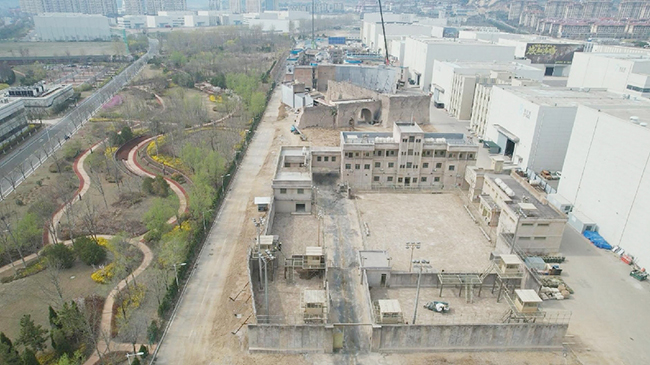
The trending Chinese anti-war film "Once Upon a Time in the Middle East," produced on China's eastern coast, showcases the fast-paced growth of the country's film industry.
Released nationwide on Tuesday, the summer blockbuster has already grossed over 536 million yuan (approximately 79.5 million U.S. dollars) in box office as of 22:00 Friday.
The story follows Xu Fu, a down-on-his-luck Chinese chef portrayed by celebrated comedian Shen Teng, who travels to the Middle East to settle his debts. There, he joins forces with a local restaurant manager to operate a bustling restaurant, bringing authentic Chinese culinary traditions to a war-torn foreign land.
Director Wen Muye revealed that 70 percent of the film was shot at the Qingdao Oriental Movie Metropolis in east China's Shandong Province, while 25 percent took place in Shitanjing of northwest China's Ningxia Hui Autonomous Region. Only a small portion of the desert scenes were filmed in Egypt. The production team initially considered overseas filming due to the story's Middle Eastern setting, but conflicts in the region led them to create sets domestically.
Production designer Li Miao detailed the extensive set construction, which took several months to achieve a full-scale recreation. The team used 14 sound stages and nine workshops, replicating over 200 buildings, including structures inspired by historical Middle Eastern architecture.
"This time we recreated over 200 buildings. The walls of Kubbazabad were modeled after century-old Middle Eastern defensive fortifications, and we reworked three or four times to create a desolate atmosphere. The front hall of the Dragon Restaurant was designed with reference to Middle Eastern floor tiles, with three different kinds of marble inlaid into the terrazzo and polished piece by piece. In pursuit of realistic detail, every advertisement, graffiti, and sign on the street walls was specially designed," Li said.
"We also created a Tree of Life. Its leaves were made using steel molds. It was quite big, and we buried it deep into the ground. In the end, it stood 16.5 meters tall and took half a year to build. We hope it helps the actors immerse themselves in an authentic environment," Wen Muye added.
Gao Yonghui, assistant general manager of the studio, noted that the production utilized a streamlined industrial chain encompassing set construction, shooting and technical support, contributing to the film's shooting efficiency.
Sun Yanbin, an associate professor with the Beijing Film Academy, emphasized that the film's intricate production is a manifestation of the industrialization of China's film sector. The highly realistic set design of the film ensures the progress of shooting and also enhances the controllability of film production.
Photos
