



Qingdao Today
 2026/8/12
 source:
 Print
Print
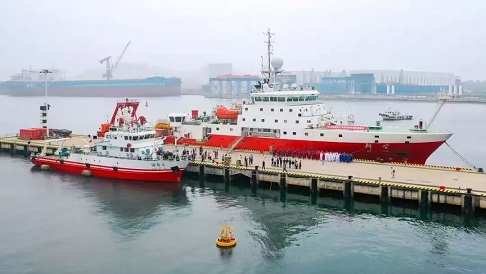
Chinese research vessel Kexue returned to Qingdao in Shandong province on Aug 7 after a 35-day expedition in the Western Pacific, covering 5,845 nautical miles to gather data and samples supporting typhoon forecasting and climate research.
Operated by the Institute of Oceanology of the Chinese Academy of Sciences, the vessel focused on two core scientific questions concerning the climate and environmental effects of Western Pacific current systems and warm pool variability, and the resource and environmental effects of the region's complex geological evolution.
The expedition coordinated multidisciplinary observations spanning air-sea interaction, physical oceanography, marine ecology, marine chemistry and marine geology.
During the voyage, the team completed a comprehensive synoptic survey, executing full-depth conductivity-temperature-depth profiles, box-core sampling, and gravity-core drilling to capture high-resolution seafloor data.
Scientists also deployed and recovered the Langya series of large profiling floats, along with drifting buoys and underwater gliders, laying a solid foundation of data and samples to address key scientific questions.
This marked a milestone in building a real-time, three-dimensional observation system. During the expedition, the array precisely tracked three typhoons: Bavi, Noul and Dolphin, recording a minimum pressure of 996 hectopascals, maximum wind speeds of around 15 meters per second, and peak hourly rainfall of about 500 millimeters.
Through coordinated observations from moored buoys, surface floats, and underwater gliders, scientists simultaneously captured the coupled evolution of the marine and atmospheric boundary layers during a typhoon, yielding rare trans-boundary-layer observational data across the ocean-atmosphere interface.
The findings hold significant scientific value for deepening the understanding of air-sea interactions and refining typhoon forecast models, while providing tangible socio-economic benefits for improving maritime safety and navigational forecasting.
With scientists predicting the Pacific could see its strongest El Nino in nearly a century this year, the expedition also conducted targeted multidisciplinary observations to study the phenomenon, a periodic warming of equatorial Pacific waters that can disrupt weather patterns worldwide. The team collected more than 900 liters of subsurface seawater and over 8,000 liters of surface water, which will be analyzed for temperature, salinity, pH, dissolved oxygen, chlorophyll, sulfides, chlorofluorocarbons, polycyclic aromatic hydrocarbons, mercury and radioactive isotopes.
By comparing the samples with data collected over the past 14 years, researchers aim to determine how the Western Pacific marine environment responds to strong El Nino events, providing essential field data for climate change research and prediction.
Photos
