



Business
 2025/11/21
 source: International daily
 Print
Print
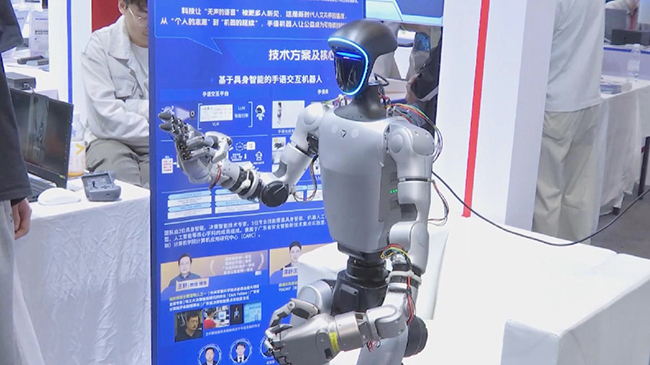
The 27th China Hi-Tech Fair heldin Shenzhen City, south China's Guangdong Province has spotlighted embodied-AI robots, with research teams presenting breakthroughs in robotic dexterity from sign-language-capable humanoid hands to e-skin gloves for tactile perception AI models.
Themed "Technology Leads Development, Industry Integrates Fusion," the three-day event attracted over 5,000 companies and organizations from more than 100 countries and regions, and received over 450,000 visitors.
The exhibition, which concluded on Sunday, featured the release of over 5,000 new products, technologies and innovative solutions.
Researchers from the Computer Application Research Center at Harbin University of Technology Shenzhen unveiled China's first sign-language robot.
According to the developers, the team has been working on their own sign-language database since 2008. With recent advances in embodied intelligence, it has now been integrated with robotic hands to perform sign language.
"There is no publicly available dataset for sign language in the world. So we manually logged over 5,000 sign language gestures with a sign language synthesis system, including their interactions. Our design allows universal adaptation, because no matter what type of robotic hand is used, the execution data of our signbank are defined by the hand's end-posture. By specifying the spatial position of each finger and the wrist, the system automatically calculates the required angles and postures with the coordinates given, regardless of the kind of robot or arm you are using. This enables highly universal adaptation," said Lyu Junzeng of the research center.
Equipping robots with human-hand-like perception requires additional sensing technologies, and Chinese flexible tactile-sensor developer Tachin Tech provided their latest solution -- a full-palm electronic-skin tactile glove.
The glove can record temperature, pressure, and other data in real time, improving robots' ability to gather information and perceive their environment.
"Inside the glove is a thin layer of soft electronic skin. When we transplant this skin into the glove, it equips the glove with many new functions. The sensitivity of our glove is up to 0.01 newtons per square centimeter. With more than 1,000 sensors embedded in this small soft glove, we can capture over 10 megabits of data per second, which provides very strong data support for building large tactile perception data models," said Dong Zhi, co-founder of Tachin.
Photos
