





当前位置 : 洛杉矶时报增刊
 发布日期:2026/1/28
 来源:International daily
 打印
打印
2025 was a banner year for China's technology. From the world-shaking large-scale AI model DeepSeek to the robotics breakthroughs by Unitree Robotics and XPeng Robotics, from the successful 450 km/h trial runs of the CR450 high-speed train prototype to the Tianwen 2 mission opening a new chapter in asteroid exploration, China's scientific progress continued to push the boundaries of human knowledge.
What tech highlights can we expect in China in 2026? Breakthroughs are anticipated in four key areas as below.
Space: continuing preparations for a crewed moon landing
In 2026, China's space program will continue to shoot for the stars.
In low-Earth orbit, the China Space Station (CSS), known as Tiangong, will enter its seventh year of regular operations. Crewed spacecraft Shenzhou-23 and Shenzhou-24 are expected to rotate missions aboard the station. Notably, the Shenzhou-23 crew will undertake China's first long-duration residency experiment in orbit with one astronaut for more than a year, which will be a milestone in the country's crewed spaceflight history.
As for lunar exploration, China plans to launch the Chang'e 7 lunar probe. One of its core objectives is to land near the Moon's south pole to survey the environment and resources, especially water. This will have a far-reaching influence on future human survival and development on the Moon. Meanwhile, test flights of the Long March 10 carrier rocket and the new generation of crewed spaceship "Mengzhou" will continue. If successful, these developments will lay a solid foundation for China's future crewed lunar mission.
AI: "AI agents" in every household
In early 2025, China's general-purpose AI model DeepSeek burst onto the scene. In 2026, the country's AI industry is expected to sustain high-growth momentum, shifting its focus from simple model building to deeper industrial integration and real-world application.
China's share of total computility dedicated to intelligent workloads is expected to exceed 35% in 2026, with domestic chips reaching large-scale application in select scenarios and a hardware-software co-design ecosystem taking shape.
Both "software agents" and "hardware agents" are expected to see rapid adoption. Software agents that can autonomously operate computers and perform complex tasks will be applied across finance, healthcare, education, and more. As for hardware agents, terminal products such as interactive robots and AI earbuds will accelerate commercialization and open new consumer markets. IDC predicts that by 2026, 50% of data teams of China's top 500 enterprises will use AI agents for data preparation and analysis.
The application of AI will also rewire the end-to-end intelligent reconstruction of traditional industries. In manufacturing, smart factories will grow in both number and sophistication, driving ongoing productivity gains. Embodied AI will break out of the virtual realm and scale in warehousing, logistics, and commercial services, and create synergies with sectors such as autonomous driving and XR technologies.
New Energy: Installed green energy capacity to surpass 200 million kilowatts
In 2026, China will continue to elevate its share of new energy in total power supply, with building a new energy system as a core goal.
China is expected to install more than 200 million kilowatts of new wind and solar capacity throughout the year, further increasing the share of wind and photovoltaic power in China's total electricity consumption.
With the convergence of AI and energy, the energy storage industry will evolve from a supporting role to a central player. The boom in building AI compute centers will create new growth engines for energy storage. Data centers require high power quality, continuous supply, and fast grid integration, making storage systems "strategic infrastructure" for rapid commissioning and stable operation.
Solving charging bottlenecks will further boost the penetration of new energy vehicles, while the deep integration of intelligence and electrification will deliver a new mobility experience for users.
(小标题)High-speed Railway: Embracing 400 km/h service
By the end of 2025, with the opening of lines such as the Guangzhou-Zhanjiang high-speed railway, China's total high-speed rail network exceeded 50,000 kilometers.
In 2026, China Railway plans to open over 2,000 kilometers of new lines, which will further expand the density of the national rail network and especially enhance corridors connecting Xinjiang and Xizang, as well as routes along border areas, coastlines, and rivers, effectively bolstering overall interregional connectivity. By 2030, China's total high-speed rail operating mileage is expected to reach around 60,000 kilometers.
On the technology front, China's high-speed railway will continue to set global trends. The eagerly awaited CR450 trainsets (the new generation of Fuxing high-speed trains) are expected to complete final design in 2026, with performance reaching world-leading levels to further enhance operational efficiency and safety. Critical technologies for 400 km/h high-speed rail infrastructure will also enter experimental verification stages.
In 2026, China will unveil a remarkable blueprint in technology. From the heights of the cosmos to the depths of life, from the computing power that propels the future to the railway network that connects the world, each advancement contributes Chinese wisdom to humanity's exploration of the unknown.
Repoter:Zhao Peng
Picture:Xinhua
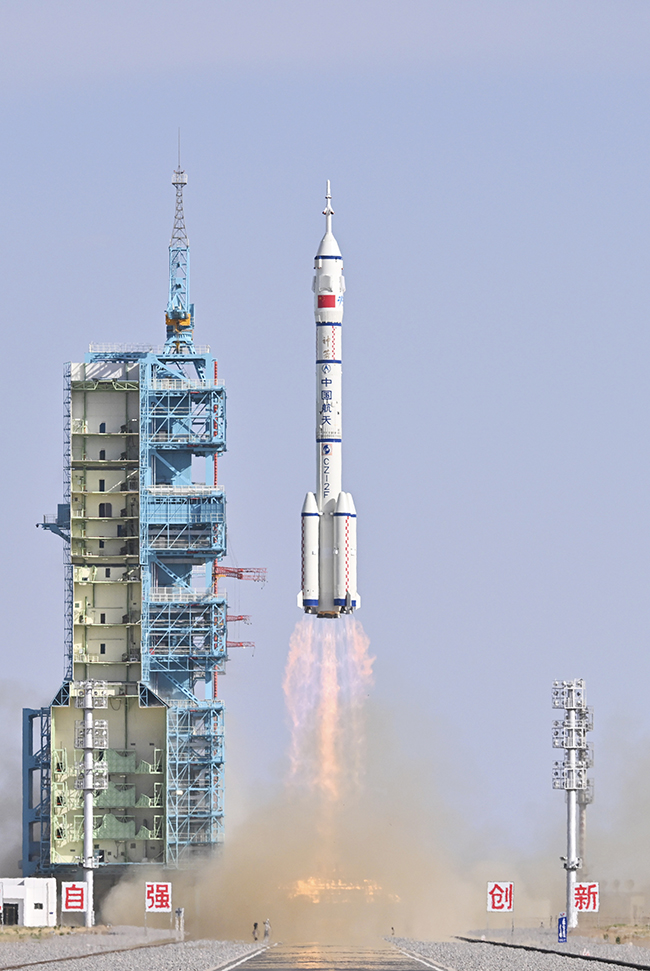
1.The Chinese Long March rocket carrying the Shenzhou-20. manned spaceship lifted off.
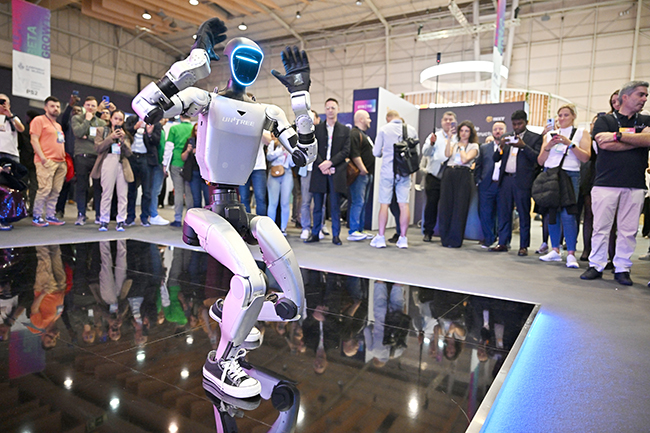
2.China's Unitree Robot.
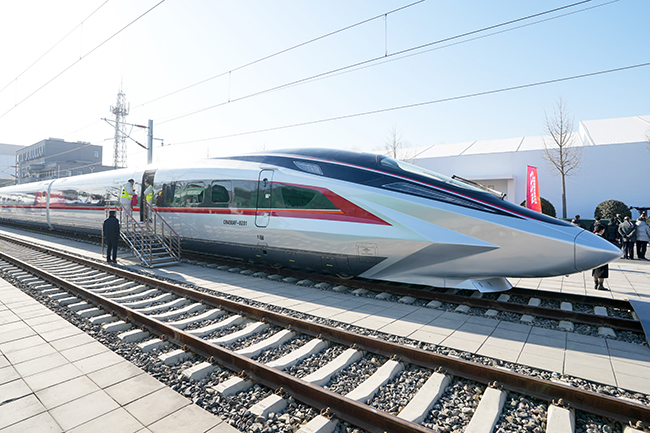
3.China's CR450 Fuxing bullet train, with a maximum speed of 453 km/h.

4.DeepSeek AI Large Language Model(LLM).

24小时最新动态

热点排行
图片新闻