





当前位置 : 洛杉矶时报增刊
 发布日期:2026/1/28
 来源:International daily
 打印
打印
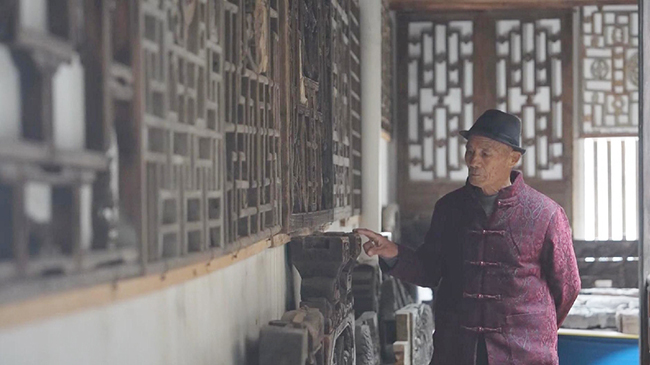
GUILIN -- Tang Yijin, an 82-year-old carpenter from Guilin City of south China's Guangxi Zhuang Autonomous Region, has spent 16 years in transforming his lifelong passion into a remarkable achievement -- relocating and restoring 20 nearly-demolished traditional residences of the Ming Dynasty (1368-1644) and Qing Dynasty (1644-1911).
With his savings from years working as a house builder, he built the Siyuan Folk Customs Museum, which now covers over 8,000 square meters and has become a culture relic protection site designated by the local government.
Beyond the museum's main exhibition halls exhibiting antique objects, the museum also include 13 halls displaying financial culture and traditional rituals as Tang's dream has always been to showcase the production, lifestyle, and folk customs of northern Guangxi.
Since he was 16, Tang learned woodworking and traditional brick and tile techniques from master craftsmen. For him, "learning to apply skills" means passing down old crafts and protecting historic artifacts.
"The valuable cultural heritage left by our ancestors is rare and worth preserving and protection. This isn't just a fleeting passion. It's my lifelong pursuit," he said.
The story of his dedicated efforts began in 2009, when Tang, then 65, learned that a batch of Qing Dynasty residences in Yongsui Town of Quanzhou County would be demolished. Deeply distressed, he resolved to save these historic structures. Despite numerous challenges, he decided to relocate the old houses to nearby sites and restore them to their original appearance.
"The original structure was 40 meters wide and 60 meters deep, covering an area of 2,400 square meters. It included 14 ancient residences, all restored to their original layout, dimensions, and height, exactly the same in their old ways," said Tang.
Using his savings accumulated over the years, Tang persuaded local villagers to sell him the old residences. In some 40 days, he led a team of over 20 craftsmen to carefully document, disassemble, and transport each brick, beam, and pillar, and trucked them to their new sites in more than 100 trips. Every component was numbered, photographed, and stored with precision.
By 2010, the first house was successfully reconstructed. Since then, Tang has tirelessly restored all the structures, bringing the old residences back to life.
"My father had four daughters and two sons. So, eight people live here. This room serves as the kitchen, and the inner room houses all eight of us. My mother is a weaver. It's been so hard for Tang to accomplish such great work. It's amazing how a villager can have such great capabilities and a strong determination to do so," said Jiang Shengqian, a descendant of one of the original house owners.
To many locals, Tang is both a venerable elder and an eccentric, stubborn old man. He is someone who, despite being well into his retirement years, devotes his all to realizing his dream of building a folk customs museum.
"I was thinking about building a folk customs museum by starting with rebuilding these old houses. So, I gathered all resources I could find and spent all my energy on trying to turn this dream into reality," said Tang.
Now, Tang's efforts culminated in the museum, which includes over 20 ancient residences and 22 replica buildings. He also collected more than 20,000 folk artifacts and over 60,000 ancient coins from the surrounding regions.
"It has basically taken shape and been presented to the public, which is the greatest comfort to me. My dream has come true. Now, I'm considering how to hand it over to the state safely, and that's my only concern," said Tang.
Recently, the museum welcomed the visit of a group of pupils, who were there to learn and appreciate the country's rich cultural heritage.

24小时最新动态

热点排行
图片新闻