





当前位置 : International Daily News
 发布日期:2025/10/28
 来源:International daily
 打印
打印
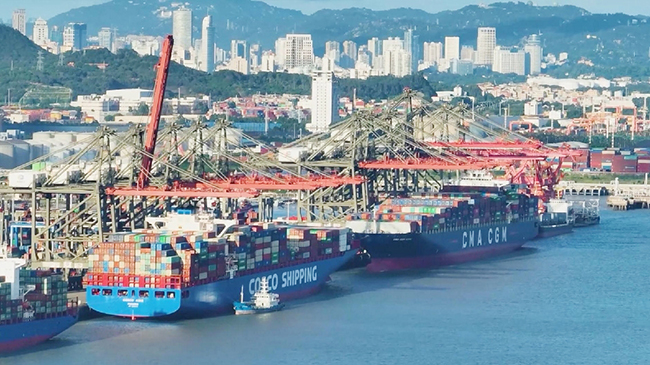
China's foreign trade sustained steady growth in September despite external headwinds, thanks to its continuous efforts to promote industrial upgrading and intelligent manufacturing, according to a Chinese expert.
China's total goods imports and exports in yuan-denominated terms surged 8.0 percent year on year to 4.04 trillion yuan (about 567.94 billion U.S. dollars) in September. Exports climbed 8.4 percent to 2.34 trillion yuan (about 329.29 billion U.S. dollars), while imports rose 7.5 percent to about 1.70 trillion yuan (about 238.64 billion U.S. dollars), according to the latest data released by the National Bureau of Statistics.
"Since April 2, when the United States imposed 'reciprocal tariffs,' the external trade environment for us has indeed worsened. However, the data show that the resilience of China's export competitiveness beats the expectation. Although China's export share and the growth in North America have declined sharply, exports to non-U.S. markets have expanded steadily. The expansion is primarily driven by China's extra-strong competitiveness in innovation and large-scale manufacturing," said Liu Yuanchun, president of the Shanghai University of Finance and Economics, in an interview with China Central Television.
Liu attributed China's export strength to long-term structural shifts in its industrial base. Over the past decade, the country has invested heavily in industrial upgrading, intelligent manufacturing and innovation. These efforts have significantly lowered production costs and improved efficiency, Liu said.
"Since 2016, China has been facing a deteriorating external environment, but its exports have never collapsed, becoming a highlight in the global economy and a pillar for healthy development of the Chinese economy. It is not simply a result of policies that have been implemented or random events. It is a result of a decade-long push toward industrial upgrading and intelligent manufacturing, which has enabled rapid cost reductions and efficiency gains through innovation and large-scale production. This has rapidly boosted our competitiveness," he said.
China's strategy of promoting openness amid rising global trade protectionism has helped expand trade in emerging markets and mitigate geopolitical friction, according to the expert.
"Over these years, global trade protectionism has been on the rise. In response, we have promoted openness to offset the impact of blockage and continued to promote liberalization of global trade. This has enabled us to significantly expand into many new markets. With such a trade policy for diversified markets, we have successfully withstood external pressures stemming from geopolitical trade frictions," he said.

24小时最新动态

热点排行
图片新闻