



Qingdao Today
 2023/6/30
 source:
 Print
Print
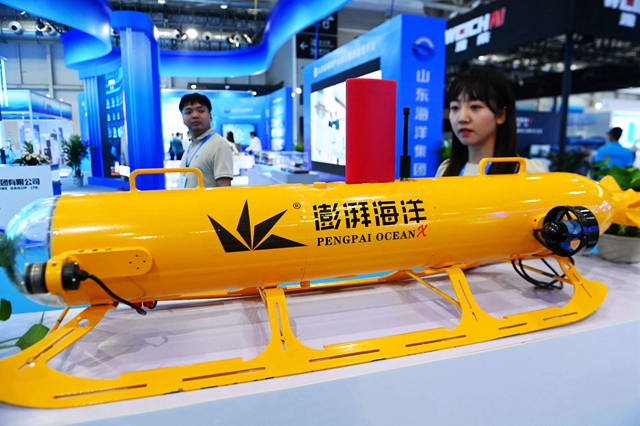
People visit the 2023 East Asia Marine Expo in Qingdao, East China's Shandong province, June 28, 2023. [Photo/IC]
Worldwide officials, scientists and experts gathered on June 28 with a shared commitment to strengthen international cooperation on global ocean governance. They pledged their support for the United Nations Decade of Ocean Science for Sustainable Development, aiming to foster a community with a shared future for mankind.
Launched in January 2021, this initiative, also known as the "Ocean Decade", serves as a framework for stakeholders worldwide to collaborate and trigger a revolution in ocean science, as stated on its official website.
During the opening session of the 2023 East Asia Marine Cooperation Platform Qingdao Forum, Peter Thomson, the UN Secretary-General's Special Envoy for the Ocean, emphasized the changing marine ecosystems due to factors such as warming, acidification and deoxygenation.
He highlighted the potential extreme effects on aquatic food and economies. Thomson stressed the importance of recognizing the implications of these evolving ocean realities caused by human-induced atmospheric changes.
The forum, held in Qingdao, Shandong province, attracted over 400 participants from more than 30 countries and regions. Participants engaged in discussions related to various aspects of ocean development, including ecological protection, industries, and science and technology.
Thomson expressed his satisfaction that the UN Decade of Ocean Science had made significant progress since its launch in 2021, with increased levels of ocean seafloor mapping, observations and research.
He emphasized the need to base humanity's response to the challenges of the twenty-first century on the best available scientific knowledge.
Richard Tur de la Concepcion, the main negotiator of the Cuban G77/China Chairmanship, emphasized the importance of the event for developing countries.
He highlighted the oceans' significance as habitats for 80 percent of all life and facilitators of 80 percent of global trade, providing food, jobs and income for nearly 3 billion people, primarily in developing countries. However, these benefits are currently not accessible to everyone equally, and the oceans remains under severe threat from human activities that prioritize economic profit over environmental preservation.
Concepcion stressed the urgent need to mobilize resources for implementation, including financing, technology transfer, capacity building and scientific research. These measures would improve ocean's health, foster marine biodiversity, and contribute to the development of the Global South.
Jiao Nianzhi, an academician of the Chinese Academy of Sciences, led a research team that collaborated with global scientists on the Ocean Negative Carbon Emissions (ONCE) initiative.
Their goal was to find scientific theories and solutions to increase ocean carbon sinks, addressing climate change and working towards carbon neutrality, said Jiao during the forum, who also explained that understanding the mechanisms and processes involved in increasing ocean carbon sinks through anthropogenic means could contribute significantly to carbon neutrality.
The ONCE program has evolved into an international network of projects and experts, bringing together 78 teams from 33 countries. By coordinating research efforts and promoting ocean-based solutions for climate mitigation, this initiative aims to make a substantial impact.
The East Asia Marine Cooperation Platform, located in the Qingdao West Coast New Area, operates as a high-level program under the Belt and Road Initiative framework. Its annual Qingdao Forum and East Asia Marine Expo have gained recognition as influential marine events in the region.
In February, the UN Ocean Decade Collaborative Center on Ocean-Climate Nexus, the only one in Asia, and the Ocean Decade International Cooperation Center, the only one in China, were both unveiled in this area, further reinforcing its significance in promoting sustainable ocean science and cooperation.
Photos
