



Qingdao Today
 2026/10/13
 source:
 Print
The coastal city of Qingdao in East China's Shandong province, with its 882.92-kilometer coastline and 49 bays, is pioneering a "one bay, one policy" framework to balance urban development with marine protection. The approach combines land-sea coordination, ecological restoration, and value transformation.
In Jiaozhou Bay, known as Qingdao's "mother bay", authorities have enacted the nation's first local law dedicated to protecting a single bay. A three-tier bay chief system integrates river, forest, and bay governance. Thousands of sewage outlets have been brought under unified national supervision, and invasive cordgrass has been cleared from nearly 7,000 mu (466.67 hectares) of tidal flats, with native seepweed replanted.
The ecological recovery is already yielding positive results. Along Laoshan Bay, more than 800 homestays generate over 300 million yuan ($44.82 million) annually. In Lingshan Bay, a seaside cafe owner reports 200 daily customers and nearly 100,000 yuan in monthly revenue during peak season. In 2025, Qingdao's maritime tourism welcomed 4.63 million visitors.
Eco-value transformation is accelerating. A pioneering offshore photovoltaic project in Aoshan Bay produces 1.07 billion kWh of green electricity annually while cultivating sea cucumbers and snails beneath the waves.
Lingshan Island, China's first carbon-negative island, has raised forest coverage above 80 percent through reforestation and clean energy. Its ecosystem product value hit 706 million yuan in 2024, growing steadily for three years.
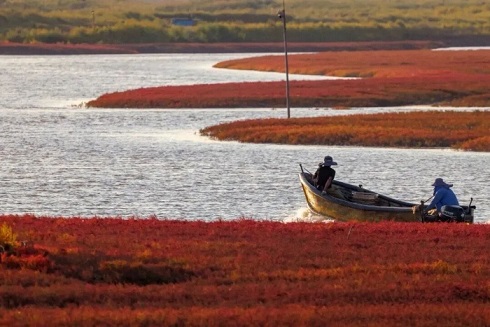
Qingdao's Jiaozhou Bay, where red seepweed blankets the tidal flats and migratory birds return, paints a vivid picture of harmony between city and sea. [Photo/IC]
Photos
