



Qingdao Today
 2023/11/30
 source:
 Print
Print
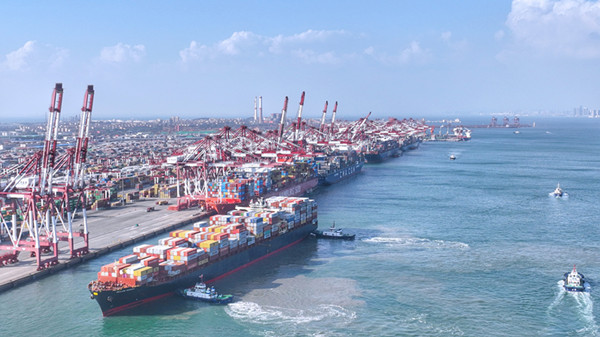
The busy Qingdao Port. [Photo provided to chinadaily.com.cn]
Using its advantageous location, Qingdao is accelerating efforts to build an international transportation network that serves as the most convenient outlet for the Yellow River basin.
Building infrastructure is a prerequisite for creating an open gateway and Qingdao is advancing the construction of infrastructure such as ports and railways to enhance the city's capacity, said Xie Hongjin, vice-mayor of Qingdao.
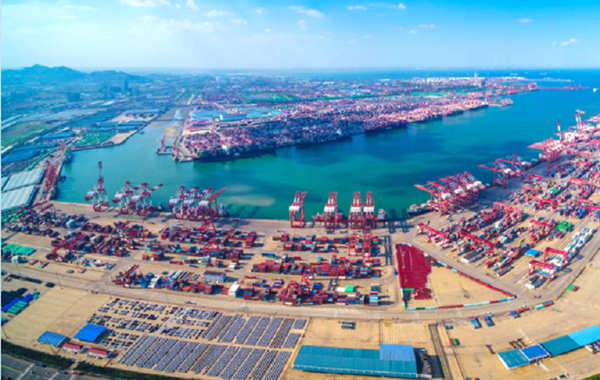
Qingdao Port boasts a 400,000-ton iron ore wharf, the world's largest. [Photo provided to chinadaily.com.cn]
According to Xie, as of now, Qingdao has a total of 124 production berths in its ports, including 98 berths that can accommodate vessels of more than 10,000 metric tons, with a designed annual throughput capacity of 387 million tons.
Qingdao Port boasts a 400,000-ton iron ore wharf, the world's largest; a 450,000-ton crude oil wharf; the largest bulk grain unloading and transferring capability port in the Yellow River basin; Asia's first fully automated wharf and an international first-class cruise passenger terminal.
The port can accommodate the world's largest ships capable of loading 24,000 standard containers and 225,000-ton cruise ships, and is one of the most comprehensive ports in the world in terms of cargo services.
In conjunction with the port development, Qingdao is improving the functionality of its coastal railway hubs. The city has ramped up efforts in the construction of a rail transportation system that integrates trunk, intercity and urban-suburban railways as well as urban rail transit.
The Weifang-Yantai high-speed railway under construction is expected to be put into operation in 2024. The connecting rail line for the Weifang-Suqian high-speed railway via Qingdao will commence soon this year, to establish a speedy link between Qingdao and the Yangtze River Delta region.
Focused on enhancing the allocation of shipping routes to countries involved in the Belt and Road Initiative and member states of the Regional Comprehensive Economic Partnership, Qingdao has optimized the layout of shipping routes to Europe and the United States. Since the beginning of this year, Qingdao Port has added 18 new shipping routes, bringing the total to more than 220, with the highest density of shipping routes in northern China.
As well, the city has expanded and restored international flights to support air transportation. This year, Qingdao opened three all-cargo flights to New York, Toronto and Frankfurt, a passenger flight to Kathmandu, and 11 international and regional cargo routes. By the end of October, Qingdao Jiaodong International Airport had handled 1.06 million international and regional passengers and 104,000 tons of cargo, a year-on-year increase of 999.7 percent and 25.7 percent, respectively.
To assist logistics in the Yellow River basin, Qingdao Customs has introduced a regulatory model to help businesses deal with customs clearance. The city has also opened 74 intermodal routes to six inland ports, lowering transportation costs by 20 percent.
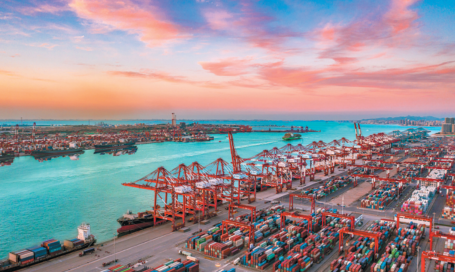
Qingdao Port is one of the most comprehensive ports in the world. [Photo/China Daily]
Photos
