



Business
 2025/7/4
 source: International daily
 Print
Print
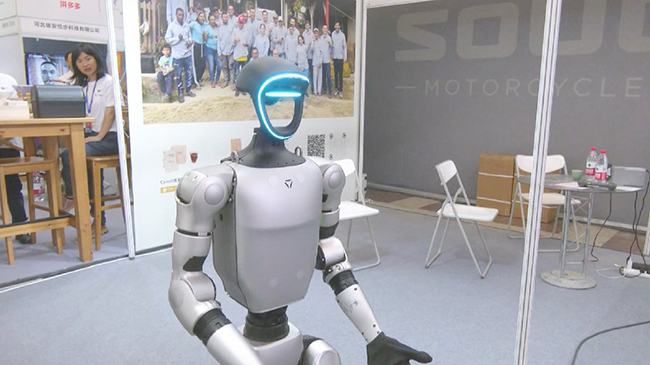
Smart humanoid robots and bionic products have caught much limelight at the first Good Living Expo running from Friday to Sunday in Beijing, as cutting-edge technologies are entering the life of ordinary people and quietly changing consumption patterns and the rythem of life.
At the expo, the humanoid robot and quadruped robot showcased by Unitree Robotics, one of Hangzhou's "Six Little Dragons" representing emerging enterprises with substantial influence in cutting-edge technology fields, took the center stage, attracting the attention of many visitors.
BrainCo, a neurotechnology company and one of the "Six Little Dragons" as well, showcased its cutting-edge bionic technology at the expo through product experience officer Jiang Songning.
Jiang, who lost his right hand, demonstrated the capabilities of the company's smart bionic hand by performing a piano piece with fluid precision. The bionic hand can also carry out tasks such as calligraphy, cocktail mixing, and latte art.
"When our brain envisions a movement, it generates neural electrical signals and electromyographic signals. A circular array of sensors on the contact chamber sleeve captures these signals. AI algorithms then decode the movement intention in real-time, enabling the bionic hand to execute the desired motions," Jiang said.
Over recent years, science and technology have created an increasing number of new consumption scenarios, ushering in a new way of life for everyone, and giving rise to more new consumption scenarios.
For instance, the world's first smart delivery-integrated coffee robot has been commercially launched in Nanjing, east China's Jiangsu Province. This robot is capable of both preparing coffee on-site and supporting unmanned vehicle deliveries.
Moreover, achievements in emerging sectors such as multi-rotor drones and general humanoid robots have been unveiled in Nanjing, driving new trends in upgrading consumption through the integration of industries and innovation.
"This robot can perform basic voice interactions and is suitable for children's education or healthcare applications. Small-scale production of it can be achieved in the second half of the year," said Bao Huiting, ecosystem manager of Huaxia Robotics (Nanjing) Co., Ltd.
Photos
