





当前位置 : 北美新闻
 发布日期:2024/11/5
 来源:
来源:
 打印
打印
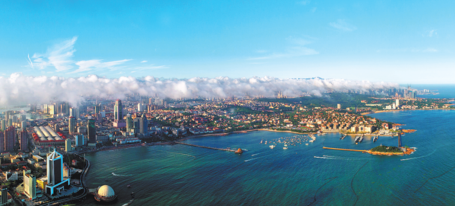
An elevated view of Qingdao's coastline. QIN LING/FOR CHINA DAILY
In the golden autumn season, which is also the peak fishing season, in the Xihai'an (West Coast) New Area in Qingdao, nearly 3,333 hectares of modern marine ranches send around 20 metric tons of fresh fish such as sea bass, bream, and yellow croaker to various parts of the country every day.
To build itself into a "blue granary", Qingdao has built 21 national-level marine ranches, invested in advanced marine aquaculture equipment such as Deep Blue No 1, and achieved an annual output of aquatic products reaching 1 million tons.
By focusing on the industry related to the ocean, Qingdao aims to develop and strengthen the marine economy. Recently, a floating lidar wind measurement radar deployed near Qingdao's coast for offshore wind power projects was completed. This radar can provide real-time monitoring of the environment below 500 meters in height and within a radius of about 10 kilometers. Even in complex weather conditions, it can transmit wind direction, wind speed and other information back to a big data platform.
One of the developers of this lidar radar, Wang Qichao, said that the construction cost of this project is one-third of traditional methods and can provide long-term intelligent operation and maintenance services for offshore wind farms. So far, this project has served more than 50 offshore wind farms in China.
In recent years, Qingdao has introduced a series of supportive measures including various policies, funding and talent introduction for the marine electronic information industry, which encompasses satellite remote sensing, radar monitoring and underwater robots. To date, more than 110 high-tech enterprises have been nurtured. The technological achievements incubated by the projects are widely applied in marine engineering, energy development and other fields.
While accelerating the cultivation of future marine industries, Qingdao is leveraging its advantages in having multiple marine research institutions and concentrated marine science and technology platforms to expedite the development of emerging industries such as marine equipment, marine pharmaceuticals and marine renewable energy. A 210,000-ton ship developed by China Shipbuilding Corporation's Qingdao Beihai Shipbuilding can help reduce emissions by 95 percent of carbon dioxide and particulate matter, as well as nearly 100 percent of sulfur oxides compared to those fueled by traditional energy.
Currently, Qingdao has gathered 100 shipbuilding and marine engineering manufacturing companies and related supportive enterprises, forming a complete marine engineering equipment manufacturing industry chain.
In the first half of this year, Qingdao's marine GDP reached 267.16 billion yuan ($37.5 billion), a year-on-year increase of 7.7 percent.
Meng Qingsheng, head of the Qingdao marine development bureau, said that over the past three years, Qingdao has introduced more than 100 professional teams to develop marine high-tech enterprises, accelerating marine technological innovation and the upgrading of traditional marine industries.
The city is also expediting the layout of future industries such as marine electronic information and deep-sea exploration to develop new quality productive forces tailored to local conditions, Meng said.

24小时最新动态

热点排行
图片新闻